


AmplifyIE™
When inclusion lives in programs, it stays optional.
Inclusive Excellence (IE) makes it the standard.
Inclusive Excellence (IE) is the next step beyond traditional DEI—embedded into leadership expectations and the systems that shape employee experience. It creates the conditions high-performing cultures need: psychological safety, trust, and accountability so organizations consistently unlock the value of their full workforce and culture drives performance.
Recognizing the Business Conditions That Demand Culture Work
The work usually begins not with a culture problem, but with a business condition that has begun to expose one. Do any of these sound like the room you are sitting in right now?
Culture Integration After a Merger or Acquisition
Two organizations have merged on paper. The org chart is settled. But "culture fit" friction is showing up in decisions, trust, and day-to-day ways of working that leadership didn't anticipate.
Are your teams operating as one organization or as two that happen to share a name?
When Rapid Growth Outpaces Your Culture Infrastructure
The business is scaling fast. New people, new teams, new markets. But the systems, manager capability, and norms that used to hold things together informally are no longer sufficient for the organization you are becoming.
Is culture growing with you or quietly falling behind?
Navigating Inclusion Under Legal, Political, or Public Scrutiny
The climate has made it harder to talk about inclusion openly. Legal caution, political pressure, or public scrutiny has changed the language but the underlying performance need hasn't changed. The work still matters. The approach has to adapt.
What does the work look like now, and is it the version you intended?
Performance Pressure and the Culture Friction No One Is Naming
Execution is lagging. The strategy is sound. The talent is there. But something in how decisions get made, how accountability works, and how leaders behave day-to-day is creating friction that no one has named yet and that the performance dashboard can't see.
Is the drag on performance coming from strategy or how the culture actually operates?
Rebuilding Trust After Restructuring or Workforce Reduction
The restructure is done. But the people who stayed are watching carefully. Trust is thinner than leadership realizes, and the path forward depends on rebuilding it deliberately rather than assuming time will do the work.
Do your leaders know what employees are actually thinking right now — or are they guessing?
Leadership Transition: When Culture Is Carried by a Person, Not a System
A respected leader is leaving — or a new one has just arrived. The culture has been held together by relationships and presence. The question is whether it can hold without them, or whether it needs to be rebuilt on a more durable foundation.
If your strongest culture carrier left tomorrow, what would actually hold?
Multi-Region Inconsistency: When HQ and the Field Tell Different Stories
The culture described in leadership meetings is not the culture experienced on the ground. Norms, expectations, and leadership behavior vary significantly across locations, business units, or teams — and the gap is widening.
Would employees in every region describe culture in the same way?
Culture Fatigue: When Your People Have Seen This Before
Employees and leaders have watched initiatives launch and fade. The language is familiar. Confidence in follow-through is low. The next move cannot look like the last one — it has to be better for everyone or it will not work at all.
What would make this effort land differently than the ones that came before it?

THE BUSINESS CASE FOR CULTURE
Culture Has a P&L™
Culture does not appear as a line item. But the cost of misalignment is already buried in payroll, replacement costs and management overhead.
CulturLens™ makes that hidden cost visible.
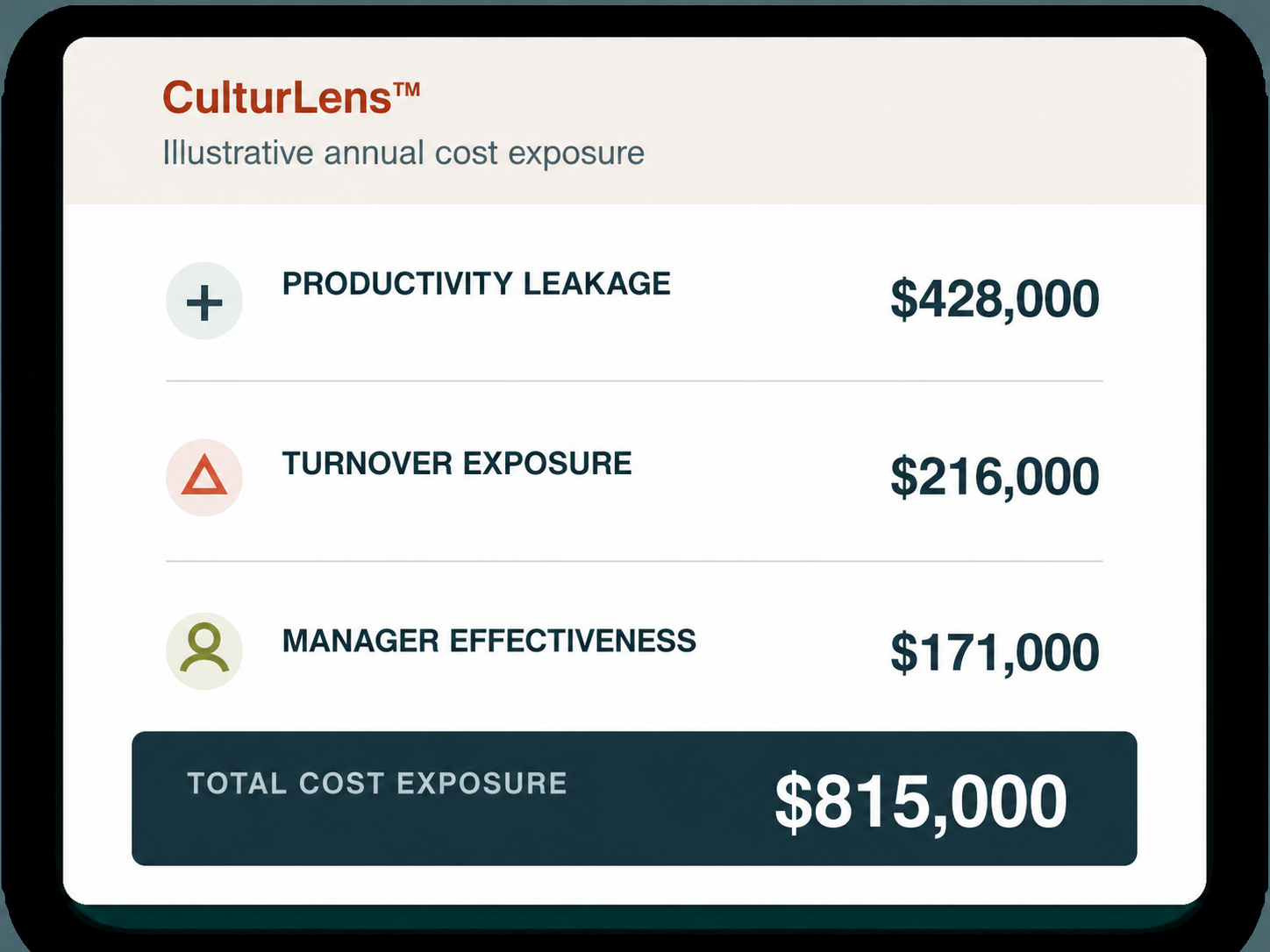
Turn workforce friction into a conservative financial estimate leaders can examine, discuss and act on.
Every organization experiences culture differently, but hidden costs usually emerge through three measurable performance levers
FIND THE MONEY YOUR P&L IS ALREADY LOSING
01
Productivity Leakage
When headcount costs rise but output does not keep pace.
02
Turnover Exposure
When high performers go quiet, disengage or leave.
03
Manager Effectiveness
When managers spend time fixing preventable culture issues.
THE NUMBER IS THE STARTING POINT
Once the cost is visible, we identify what is driving it and the right level of intervention.
LET’S DISCOVER YOUR ORGANIZATION’S
CULTURE MISALIGNMENT COST.
① Identify » ② Clarify » ③ Recover
Executive Knowledge Hub
Before organizations invest in culture, executives typically ask the same questions. Here are the answers to the ones we hear most often.
Questions HR & Finance Leaders Ask
-
Culture may not appear as a line item on your financial statements, but its consequences do. Every organization already pays for culture through productivity, turnover, manager effectiveness, execution, innovation, and customer experience. Culture Has a P&L™ is the philosophy that these hidden costs can be identified, measured, and addressed using data leaders already have.
-
Yes.
We estimate the financial exposure created when culture misalignment affects performance. Lost productivity, avoidable turnover, manager time spent resolving preventable issues, and reduced execution all create measurable business costs
-
Culture misalignment occurs when leadership behaviors, systems, incentives, communication, or workplace expectations prevent employees from contributing at the level your business strategy requires.
The result isn't simply lower engagement.
It often appears as slower execution, unnecessary rework, higher turnover, decision delays, inconsistent leadership, and reduced organizational performance.
-
CulturLens™ uses three cost levers drawn from your existing HRIS and workforce data to surface a conservative estimate of what culture misalignment is already costing your organization each year. The inputs are numbers you already have. The methodology that connects them is proprietary.
-
Accounting systems measure financial transactions.
Culture influences the behaviors that create those transactions.
Instead of appearing as a separate expense category, culture affects payroll efficiency, replacement costs, operational performance, management capacity, innovation, and execution. The costs exist. They're simply distributed throughout the business.
-
HR understands workforce dynamics, leadership capability, organizational systems, and employee experience.
Finance evaluates investment decisions, risk, return, and resource allocation.
When both functions work together, organizations move beyond discussing culture as an initiative and begin evaluating it as a business performance strategy.
-
No.
CulturLens™ is an executive decision-support tool designed to help organizations understand the potential business impact of culture misalignment. It establishes a baseline for strategic discussion and should not be interpreted as a financial audit or accounting opinion.
-
Most organizations complete Prism™ in approximately 30 minutes using information they already track, including headcount, salary ranges, turnover, and manager data.
-
Knowing the number is only the beginning.
The next step is determining what is creating the cost.
During a strategic consultation, we help leaders determine whether the issue appears isolated, recurring, or systemic and recommend the most appropriate path forward, whether that's a Culture Signal Scan, a comprehensive assessment, leadership coaching, or an AmplifyIE™ engagement.
-
CulturLens™ was created for CHROs, Chief People Officers, HR leaders, Finance executives, CEOs, business unit leaders, and private equity operating partners who want to understand the financial impact of organizational culture before making investment decisions.
-
Inclusive Excellence is how organizations recover the value revealed through Culture Has a P&L™.
CulturLens™ helps leaders understand the financial impact of culture misalignment. The assessment then identifies the underlying organizational conditions contributing to those costs.
Those conditions often include inconsistent leadership practices, low trust, unclear expectations, barriers to contribution, ineffective management systems, and untapped talent.
AmplifyIE™ helps organizations redesign those systems and operationalize the leadership behaviors that enable every employee to contribute at their highest level.
The goal isn't inclusion for its own sake.
The goal is creating the organizational conditions that allow leaders to fully access and leverage the talent they've already invested in—improving performance while reducing the hidden costs of culture misalignment.
-
Because organizations make better decisions when HR and Finance begin with the same business case.
Culture Has a P&L™ gives both functions a shared financial understanding of culture misalignment before discussing solutions. Once leaders can see where value is being lost, they can align around the highest-impact opportunities to recover performance, prioritize investments based on evidence rather than assumptions, and focus on recovering performance where it matters most.
Still have questions? Let’s talk.
Every organization is different. We'll help you determine whether this approach fits your business priorities before recommending any next steps.
Diagnose. Design. Deploy. Embed.
Four Pathways to High Performing Culture
Ignite
3 Month Diagnostic & Prep
Best for: Organizations ready to take the first step toward inclusive excellence.
If your leaders are saying “we need to do something” but wary of launching another initiative that drains resources without notable change, Ignite creates clarity fast. We start by establishing shared language, surfacing where inclusion breaks down in everyday systems (hiring, feedback, decisions, team norms), and pinpointing the cultural friction that’s slowing execution. You’ll get a grounded picture of readiness where momentum already exists, where risk is hiding, and what must be true before you scale. From there, we align leaders on a practical IE vision and a defensible 90-day plan that prioritizes quick wins without triggering change fatigue. Ignite is designed to help you start with confidence—equipped, validated, and ready for the real inclusion work.
Catalyst
6 Month Strategic Blueprint
Best for: Organizations needing a clear diagnosis and a strategic roadmap to guide their internal teams.
Catalyst is for organizations with pockets of progress but no unifying strategy that leaders can fund, operationalize, and hold themselves accountable to. If your inclusion efforts feel fragmented across HR, L&D, and business units, or your employee experience is inconsistent depending on manager or team, this is the reset. We translate culture signals into a clear diagnostic and an IE assessment that leaders can act on—not generic recommendations. Then we build an IE Scorecard and roadmap that clarifies what changes first, what scales later, and where governance and ownership must sit. Expect alignment that sticks: executives leave with shared priorities, decision points, and a plan that turns inclusion into measurable culture performance.
Momentum
9 Month Accelerator
Best for: Organizations ready to move from strategy to implementation
Momentum is built for the “we have the strategy, now what?” moment—when the plan exists, but leader behavior and systems haven’t caught up. This is where many organizations stall: managers are overwhelmed, accountability is fuzzy, and inclusion remains optional in the workflow. We close the execution gap by coaching leaders, equipping managers with practical tools, and piloting implementation in a way that produces evidence (not anecdotes). You’ll see what’s working through pilot implementation reporting, then refine and scale with a steering rhythm that keeps progress real. Momentum creates visible culture shift of new practices, stronger decision quality, and more consistent leadership behaviors supported by skills and systems,
Elevate
12 Month Transformation
Best for: Organizations seeking a deeply embedded partnership – including multi-department rollouts, ongoing advisory support or global considerations
Elevate is for organizations ready to make Inclusive Excellence “how we do business,” not something revisited when the climate is favorable. If you’re navigating multiple functions, regions, or legacy ways of working and need transformation that survives leadership changes—this is the engagement. We partner with you to embed IE into infrastructure: governance, talent practices, leadership expectations, operating rhythms, and the measurement systems that make accountability real. You’ll receive ongoing advisory support and continuous monitoring so the work doesn’t drift into performative activity. The result is a resilient culture system where inclusion and performance reinforce each other, and the transformation endures well beyond the consulting engagement.
Ready to discover what your culture is already costing?
Every organization has hidden costs.
Culture Has a P&L™ helps HR and Finance uncover them, build a shared business case, and determine the right path forward.